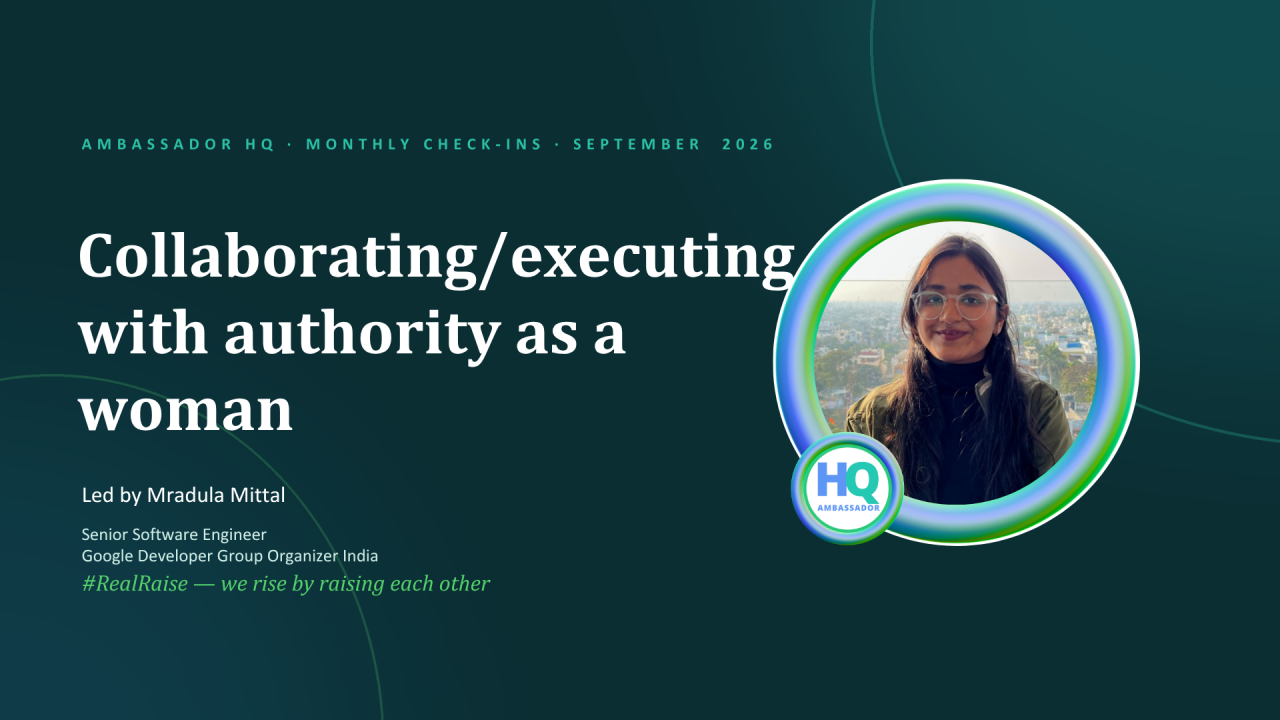
The follow-up to "Authority You're Given vs. Authority You Build" — from the Ambassador HQ community's working session on collaborating and executing with authority as a woman.
There's a lie hiding inside most leadership advice: that authority is a personality trait. Some people "have presence." Some people "command the room." You either walk in with it or you don't.
Our community knows better — because we've watched each other build it, month after month, across companies, countries, and career stages. Authority isn't a trait. It's a practice. Which means it has reps. Here are seven, road-tested by people living the double bind, not theorizing about it.
1. Retire one shrink-phrase
Not all of them. One. "Sorry, just a quick thought…" "This might be a dumb question, but…" "Does that make sense?" Pick the one you say most, and choose its replacement in advance: "Here's my recommendation." "I want to flag a risk." "What questions do you have?"
One phrase, one week, every meeting. Notice what changes — in the room, and in you.
2. Practice the pause
State your position. Then stop talking.
The qualifiers that rush in after a strong statement — "…but I could be wrong, I mean, whatever the group thinks" — are the sound of the double bind winning. Silence after a clear position isn't arrogance. It's letting your words finish their job. Count three seconds if you have to. The discomfort is the rep.
3. Put your name on a decision
Authority compounds through a visible track record. This week, write down one recommendation with your name attached — in the doc, in the channel, in the email — "I recommend X because Y." Not "the team might consider…" Not passive voice, which is where credit goes to disappear.
If it goes well, it's yours. If it doesn't, owning it is also authority — the built kind, and people notice.
4. Build some authority no title can revoke
Here's the question from our session that stuck with everyone: which kind of authority transfers when you change jobs, countries, or industries — the kind you're given, or the kind you build?
So build some of the second kind. Lead something where nobody has to follow you: a community session, a study group, a working group at work that no one owns. Volunteers choosing to follow you is the purest feedback loop leadership has. (Conveniently, we know a community that hands you a mic every month — hosting an Ambassador HQ meeting comes with a Quick Card, a workbook, and a room that wants you to win.)
5. Collaborate out loud
The trap says collaboration softens you. The counter-move is to collaborate visibly and specifically: "Building on Maha's point —" "This shipped because Ivy caught the edge case." Ask for input with a deadline attached: "Send me concerns by Thursday; I'm deciding Friday."
That last part matters. Inviting voices and closing the decision is the whole move — collaboration that ends in execution reads as strength, because it is. Collaboration doesn't dilute authority. Done out loud, it compounds it.
6. Amplify another woman in the room — every room
When she makes the point and it slides past, pick it back up with her name on it: "I want to go back to what Brandi said, because I think it's the answer." Amplification is authority you can lend — and here's the quiet secret: the person doing the amplifying builds authority too. You become the one who decides what the room hears twice.
This is #RealRaise as a meeting tactic. We rise by raising each other — literally, agenda item by agenda item.
7. Calibrate to your room, keep your core
The standard advice was written for one boardroom, in one culture. "Executing with authority" does not look identical in Bengaluru, La Paz, and San Francisco — and pretending it does sets women up to fail the local test while passing the imported one.
So separate the two layers. Style flexes: directness, formality, how disagreement is voiced. Core doesn't: clarity about what you recommend, follow-through on what you said, credit given accurately. Practice reading which is which in your own context — and compare notes with someone practicing in a different one. That's what a forty-country community is for.
The rep you can do this month
None of this is a five-step guarantee, and we're suspicious of anyone selling one. These are experiments. Run one, watch what happens, and bring the results — the wins and the faceplants — to the next Ambassador HQ monthly meeting, where the conversation continues live. Captions and live translation on, every program and employer welcome, and the room is full of people running the same experiments in very different rooms.
Which practice are you trying first? Tell us in the comments — or better, tell us what's missing from this list. The playbook is community-built, like everything else here.
We rise by raising each other. That's #RealRaise.